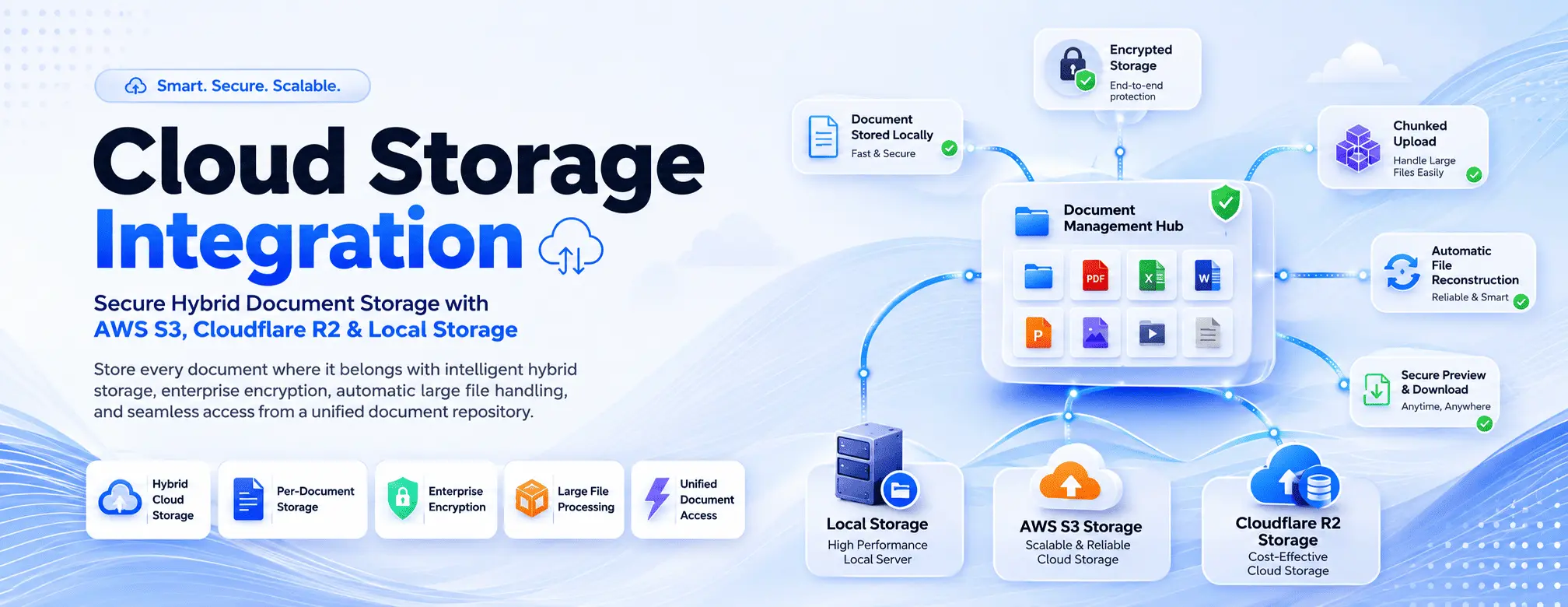
Cloud Storage Integration: Secure Hybrid Document Storage with AWS S3, Cloudflare R2 & Local

MLGLOBTECH
Jul 9, 2026
As organizations digitize their operations, the volume of data they manage grows exponentially. Contracts, engineering CAD drawings, ISO quality manuals, training videos, and high-resolution project files must remain highly secure, instantly accessible, and heavily redundant.
For modern enterprise businesses, relying on a single storage location is no longer viable. While some highly sensitive data must remain on local, on-premises servers to satisfy strict data sovereignty laws, other workloads demand the infinite scalability and cost-efficiency of cloud platforms like Amazon S3 or Cloudflare R2.
A modern Enterprise Document Management System (EDMS) solves this by providing Hybrid Cloud Storage Integration. This architecture allows organizations to combine multiple storage environments into a single, unified repository.
In this architectural guide, we will explore how intelligent cloud storage routing works, how systems handle massive file uploads, and why hybrid storage is the most secure, cost-effective approach to enterprise document management.
The Problem with Single-Source Storage
Traditional document management systems force IT administrators to make a difficult choice: host everything locally (which becomes incredibly expensive to scale and back up) or host everything in the cloud (which may violate internal security policies for highly classified files).
Growing businesses scaling on a single infrastructure frequently encounter:
Data Residency & Compliance Risks: Inability to keep specific files within specific geographic borders (e.g., GDPR requirements).
Bandwidth Bottlenecks: Struggling to upload or download massive files (like video or CAD files) over standard network protocols.
Rising Storage Costs: Paying premium storage rates for archived, rarely accessed documents.
Single Point of Failure: Vulnerability to localized server crashes or provider outages.
Hybrid cloud storage eliminates these compromises by decoupling the user interface from the backend infrastructure.
Core Capabilities of an Intelligent Hybrid Storage Architecture
To provide true enterprise-grade flexibility, a Document Management System must manage data intelligently behind the scenes while presenting a frictionless, unified library to the end user. Here are the core technical features that make this possible.
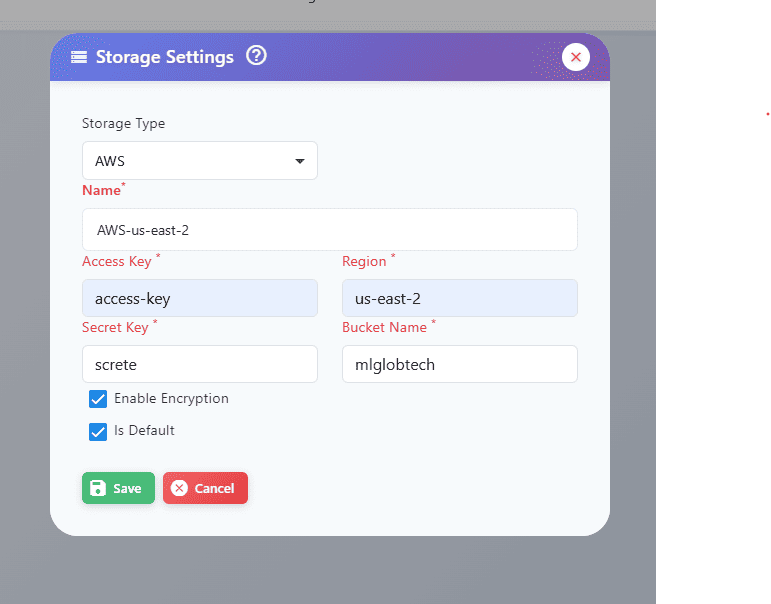
📂 Per-Document Storage Routing
One of the greatest limitations of legacy systems is that all files are dumped into the same storage bucket. Advanced hybrid systems allow for independent, per-document storage management.
For example, highly confidential HR files can be routed strictly to Local Storage, active customer contracts can be sent to AWS S3 for high availability, and massive historical archives can be routed to Cloudflare R2 to minimize egress fees. Users simply upload and access documents through a single dashboard, completely unaware of the complex storage routing happening on the backend.
☁️ Multi-Account Cloud Configuration
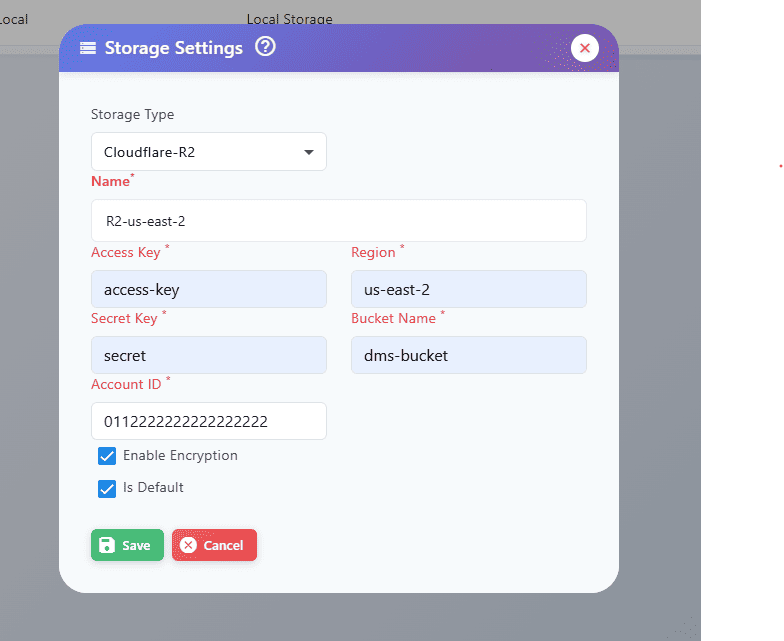
As organizations expand globally, relying on a single AWS or Cloudflare account is often insufficient. Different departments, subsidiaries, or geographic regions may require entirely separate storage environments to maintain compliance and strict billing separation.
A modern EDMS allows administrators to configure multiple cloud storage accounts simultaneously. The system tracks exactly which document lives in which specific account, giving IT total administrative control over distributed enterprise growth.
📦 Intelligent Chunking for Large Files
Enterprise organizations routinely handle massive files that standard browser uploads cannot support. Uploading a 5GB training video or architectural blueprint as a single object frequently results in network timeouts and failed transfers.
To solve this, advanced systems utilize intelligent chunked uploads. When a user uploads a massive file, the system automatically slices the document into smaller, manageable chunks behind the scenes. These chunks are uploaded independently to the designated storage (Local, S3, or R2). If a network interruption occurs, the system simply resumes the failed chunk rather than restarting the entire 5GB transfer.
🔐 Zero-Trust, Per-Document Encryption
Restricting user access via passwords is not enough; the files themselves must be mathematically protected at rest. If a malicious actor gains direct access to the AWS bucket or local server, the files should be unreadable.
Enterprise systems achieve this by encrypting documents prior to storage. Rather than using a single "master key" for the entire database—which represents a massive security vulnerability—the system generates a unique, independent encryption key for every single document. This isolated architecture ensures that even in the event of a breach, the exposure is drastically minimized.
🔄 Transparent File Reconstruction
The ultimate goal of cloud storage integration is seamless abstraction. When a user clicks "preview" or "download," the system instantly identifies the storage location (whether an AWS bucket in London or a local server in the next room), retrieves the individual file chunks, seamlessly reconstructs the original file, decrypts it using the unique document key, and serves it to the user's screen. This entire process happens in milliseconds, requiring zero technical input from the user.
Best Practices for Hybrid Enterprise Storage
To maximize the efficiency and security of your hybrid architecture, organizations should adopt the following strategies:
Classify Data by Sensitivity: Define strict rules dictating which document categories require local storage versus cloud storage.
Optimize for Cost: Utilize Cloudflare R2 for files requiring frequent downloads (due to zero egress fees) and AWS S3 for deep archival redundancy.
Enforce Universal Encryption: Never upload plain-text files to any cloud provider. Ensure your EDMS encrypts data before it leaves your secure network.
Monitor Utilization: Regularly review which cloud accounts and buckets are consuming the most data to accurately forecast IT budgets.
Frequently Asked Questions
What is hybrid cloud storage in document management?
Hybrid cloud storage is an architecture that allows an organization to use on-premises servers alongside public cloud providers (like AWS S3 or Cloudflare R2) simultaneously, managed through a single unified software platform.
Can different documents be stored in different locations?
Yes. An intelligent EDMS allows administrators to dictate storage at the individual document level, routing sensitive files locally and large, non-sensitive files to the cloud.
How do systems handle massive file uploads without failing?
Advanced systems use file chunking. They split large files into smaller pieces, upload them independently, and automatically reconstruct them when a user requests a download.
Why is per-document encryption important?
Using a unique encryption key for every single document ensures that if one key is somehow compromised, the rest of the corporate database remains securely locked.
Final Thoughts
Cloud storage integration has evolved far beyond simply pointing a software application at a single cloud provider. Today, enterprise organizations require dynamic, hybrid architectures that combine the absolute control of local infrastructure with the infinite scalability of AWS S3 and Cloudflare R2.
By implementing an architecture that supports per-document routing, intelligent file chunking, and independent document encryption keys, IT leaders can drastically reduce storage costs while fortifying their data security.
If your organization is outgrowing traditional file storage and requires a highly secure, hybrid approach, explore our Enterprise Document Management System to see how seamless multi-cloud routing and enterprise encryption can transform your data infrastructure.